 |
I hadn't, but NIU is up in De Kalb, only a four-hour drive from here. Some of my freshmen would have friends there, would have visited the campus, would have applied the year before and been accepted or rejected. The young faces settling into desks in front of me did not seem unduly disturbed, but who really knew? Did I detect more glances than usual at the door and the second-floor windows? We never lock the door, and the windows open so slightly that only a contortionist could wriggle through and dive out, down into the prickly shrubbery below. Better to take your chances holding very, very still, while the moron with the rifle chooses someone else. That classroom has pretty good computer equipment. I turned on the display, googled "NIU," and there we had it: the story almost in real-time. Eerily, it had happened in Cole Hall; our own ugly and dysfunctional building is called Coleman Hall. Around 3:00, it seemed, the gunman entered a crowded Ocean Sciences lecture from the stage side, like a guest on Leno, and began firing his shotgun into the audience. In about the time it takes to tell it (no doubt), he injured sixteen students, killed five, and took his own life. The shooter died with plenty of ammunition left and one of three pistols still undrawn, and this was counted greatly to the credit of campus security, as were the casualty figures, modest compared to Columbine, say, or Virginia Tech. The press always number the dead at such moments, using them to measure the scale of the catastrophe. I tend to think of the injured: the lives of rehab and pain, of helpless rage against a body that will never again be what it was. At least one of the sixteen died the next day, before the rest dropped from view. Will next year's think pieces refer to "the six dead in 2008's NIU shooting" - or the seven? Some kind of discussion seemed called for, in our class there in Coleman. But I am not good without notes, and in this case there was the added distraction, known about if not exactly seen, of the bodies still lukewarm, the fresh blood leaking from wounds still under the surgeon's knife. What I managed was a threadbare liberal riff. I remarked that dangerous, disturbed young men exist everywhere, but that our society seems unique in (a) its insistence that such specimens be equipped with state-of-the-art weaponry, and (b) its maintenance of a popular culture that implicitly encourages and validates the deeds of the shooters. I said some unkind things about the Burma Shave–style ads along I-57 and IL-130 north of town, placed there by an outfit called GunsSaveLife.com to celebrate the eternal fantasy of upright folk blowing holes in the bad guys. We managed a shaky laugh at "Never worry / Thugs won't attack / If the teacher / Might shoot back." We found the core proposition there quite doubtful: if you are preparing to kill yourself this afternoon anyway, an armed grammarian in bifocals is not much of a deterrent. On the other hand, accidents seemed quite likely, if my usual fumbling at the instructor's station was any sign.
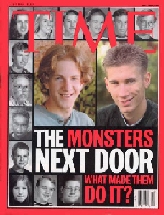
Then I recalled the cover that Time ran in the wake of the Columbine shootings. Ever eager to deplore violence and inform the citizenry, the magazine arranged the faces of the victims all around the edges, in black and white like the statistics they had abruptly become, while the shooters, Dylan and Klebold, gleamed in glowing color at the center, three times larger, enjoying precisely the immortality they had sought. After that, we got back to Hamlet. This was in every way a better response, because literature knows better than to treat life and death as data points in a political analysis. It remembers the terrible intimacy and absoluteness of one's own life, one's own death. In the midst of disaster, the question of questions, after all, is not, "How can society better prevent such harm?" but "What if it had been me?" Or "How will I face it when my time comes?" You can't do better than Shakespeare, if that is what you are wondering. But I cannot shake my sense that our ability to tune right in to the slaughter, savoring it almost as it happened, is at the heart of everything. Such acts of "random violence" are anything but random these days. They have become business as usual, predictable products that roll off the end of the socio--cultural assembly line every so often. The shooters' contempt for life, their monstrous egocentricity, sometimes looks like an all-too-logical result of acculturation in the pleasure-dome of postmodern America. On the one hand, commercial voices continuously affirm the sovereignty of the Id ("repressive desublimation," Herbert Marcuse called it) while denouncing every impulse toward self-regulation; on the other, we all regularly feast on high-quality images of bodies being beaten, broken, cut, shot, mutilated, and blown to bits, counting this as good clean fun and everyone's natural right. If you squirm at the super-sized portions of mayhem, you are as out of it as the Amish, trotting along in their buggies. It's hard to turn from this cultural context to the evening news without at least a passing sense of complicity, a feeling that thrill killings and grudge killings are part of what society has collectively willed. At what point does honest concern over the Columbine or DC shootings, say, become perverse sensationalism, culpable, part of the deep structure of the deed itself? It's impossible to say; but no one can deny that glory ranks high among the mass killer's motives. There is a feedback loop here that needs to be questioned: the nutjob does it because he knows we are watching. These days we are all paparazzi, no longer just reporting or reading the story but caught up in it, making it happen. In absolute terms, the crisis is probably not grave. Compared to even a third-rate famine, plague, war, or pogrom, Virginia Tech still looks like a day in the park, barring the statistically unlikely possibility that you are one of the victims. An old-style moralist or a newfangled sociobiologist can shrug his shoulders over it: Well, there's the human capacity for violence, doing what it does. But it is the terrible gratuitousness of these postmodern mass killings, their obscene lack of motive, that stirs a bone-deep revulsion. What they threaten is not so much our physical security as our faith that such security means anything, that it is, in the end, much worth having. Terrorists minus the faith, minus the cause, the crazies are not in most cases noticeably unfortunate or in much pain. But they seem to have looked at what life can offer — modern American life, anyway — and decided to skip it. The ultimate nihilists, taking our ethic of cool to the imaginable extreme, they seem to offer no reason for their acts beyond Why not? My college town is also a rural town, and whenever a mass killing unfolds in the national news, it is followed, as the night the day, by letters to the local paper reminding us not to blame "law-abiding gun owners" for the deeds of isolated lunatics. To say that I regard these as disingenuous would understate the case by a country mile. To be fair, there does seem to be some evidence that concealed-carry laws deter street crime. But standing where I am, too close to ground zero, I am in no mood to be fair. I note that beneath the dreams of shooting home invaders (the kind who phone ahead so that you have time to get the Uzi out of its locked cabinet) or the government (imagined as George II or Adolph Hitler returning from the dead), something more primal is at work. Whatever else it may be, the Second Amendment, these days, is demonstrably a suicide fantasy, tricked out in Enlightenment rhetoric of checks and balances. You can have my rifle when you pry it from my cold, dead fingers, runs the slogan. What comfort there is, what assurance, in that bitter vision of oneself, dead but unvanquished! Don't Tread on Me! Nemo impune me lacessit. Redneck Prozac. The thing guaranteed is not law and order or anything like it, but a sort of bottom-line existential dignity. If everything in your life goes to hell, you can still check out in a blaze of automatic gunfire, taking five or ten of the bastards with you. We are living the reality we have chosen, in other words. The shooter in the classroom or library or city council chamber is not just collateral damage, the tragic cost of proud freedoms. He is the thing itself, the essence of what was sought in the first place. The incarnation at once of our ennui and our rebellion, our self-disgust and our boundless solipsism. Call me paranoid if you like. But I find it, further, no accident that classrooms have so far been the favorite targets of the self-appointed Rambos and kamikazes, rather than movie theaters, say, or sports stadiums. Dedicated as it is to the patient, often tedious pursuit of rational solutions, and to concomitant values like mutual respect, self-restraint, and reasonable compromise, the classroom is the quintessence of everything the psycho rejects. Foreclosure of debate, of inquiry and analysis and hateful complexity, is the crux of everything his twisted fantasies aim for. He is right that we are his worst enemies. Everyone just shut up! Shut up, now! No more useless talk, just action, action of the purest, most pointless kind. So on balance I feel better and better that we got back to Hamlet that day. The discussion was not one of our best, and seemed at first a pretty puny response to the real-life carnage unfolding elsewhere. It would have made a boring movie. But in the long run, such discussions are precisely the most effective and necessary line of defense, far more important and on point than planning evacuation routes and so forth — or even than better gun control. For it is perfectly true that "people kill people," and the fact that they invariably, these days, do so with guns is secondary. What matters most is intention, the homicidal nihilism that is always an option in the psychological repertoire of Homo sapiens. There is never any guarantee that talk, mere talk, will restrain or divert this. But what else is there? In retrospect, even our choice of reading seems fortuitous. Literary tragedy is among the oldest of secular attempts to find the meaning of life in view of mortality. Tabling the cheery but doubtful prospect of an afterlife, it confronts the bleak certainties of suffering, sorrow, and death, and tries to formulate a response short of despair. The measure of its success is that we now reflexively use what was once the name of a literary genre — tragedy, the old Greek "goat-song" — to describe everything that most baffles and frightens and hurts us. To call something "tragic" is to invoke, by way of comfort, that mysterious beauty that old writers found in loss and suffering. The popular art of our day, and no doubt that of others, merely exploits violence, feeding a routine meal to a dark appetite. But tragedy in the full sense, the true sense, seeks decisive transcendence. It is premised on what Aristotle called catharsis: an exorcism of passion rather than its blind discharge in acts of real hurt; an elevating release, "calm of mind, all passion spent," in place of the atavistic explosion that is always more easily achieved. So if one day the psycho
shooter comes to my door, I know exactly what I must do. Invite
him to take a chair. Then go right on talking, till the last
possible instant.
|