|
Busing to Byzantium
couple of springs ago, my daughter and I took a bus from Thessaloniki
in northern Greece over the mountains to Istanbul. The trip was ghastly.
In an effort to save some money, I had found us seats on a local—a
big mistake. Despite the promise from the ticket vendor that no smoking
was allowed, everyone (including the driver) lit up as soon as we left
the station. Twelve hours of unbreathable air, together with the bus
stereo turned to its highest decibel with cheap bouzouki music, meant
a long night. Fortunately, I had brought along plenty to read, including
a copy of William Butler Yeats’ great poem about his longed-for
journey to this same city, but even he could never have imagined the
"Fish, flesh, or fowl" of that fumey bus. How my 16-year-old
daughter slept through it all, I’ll never know.
We arrived in dawn’s early smog. My stomach hurt from tension,
though hardly as much as it would a little later from the melting ice
in a Coke I drank, try as I might not to drink the water those cubes
were made of. I had never heard the prayer service from a minaret before,
and when I did at 5:00 A.M. while trying to hail a cab, I thought we
had landed in the middle of a revolution. I was unnerved by the exotic
cry. This was my first visit to a Muslim country, and though I had read
about what to expect, the abstract never matches the actual when traveling.
Coughing and inhaling at the same time, our taxi driver squinted through
the blue haze from his cigarette at our hotel voucher and nodded knowingly.
“See, Dad, everything’s going to be all right,” said
my yawning daughter, dismayed at my distress. She curled up in the back
while I doubled up with belly cramps in the front, the authoritative
male tourist’s place next to the driver. I would make sure he
took us there directly, wherever there was. All I knew was that we were
heading east, the rising sun a mock harvest moon through the opaque
air.
The bus terminal was apparently well west of town, or so our driver
made it seem as his beat-up Fiat banged along, hitting every pothole
he could find, and there were plenty. “This is no cab ride for
old men,” I whispered to Yeats, especially if they wear dentures–or
had, as I did, an immediate need for the bathroom. But off in the distance,
there was hope (of an aesthetic kind, at least): I could see a couple
of ships on what must have been the Bosphorus, and, in front of them
as we grew closer to the city, the silhouetted domes of the first mosques
I had ever seen.
“Look at how the light’s behind them, Meg — how they
look like they have halos,” My poetry, however, went unheard —
by my daughter anyway, who was out cold. The cabbie, however, nodded
once again as if I had given him directions and squealed the wheels
sharply left, which, for a moment, had to be north but soon became a
thousand-and-one tiny streets and intricate alleys. A Topkapi’s
worth of Turkish lire later, we pulled in front of the third hotel with
the same name as the one I had booked; this time, it was actually ours.
Over the next three days, we received the usual attention a visitor
attracts in Istanbul, especially one with a lovely young daughter along.
Even small boys had their own business cards and tried to sell us everything
from carpets and clothes to whirling-dirvish spinning tops. No matter
where we went, youthful men would trail us around, offering to be our
guides, but I suspect they were more interested in my dollars or my
daughter than in improving their English. “Hey, honey, remember
me from Honolulu?” we would hear, wandering the endless and famous
bazaar, its maze of pathways glistening with trinkets, aglow with false
gold.
It took Meg little time to realize she was outnumbered. Where are the
women, she wanted to know, or the girls her own age? We saw very few
as we wandered about; when we did, their faces and hair were always
covered. “Not a good place to buy lipstick,” she concluded,
half laughing but a little scared, too. Even with her long yellow locks
tied in a bun and blue jeans changed for a shapeless skirt, I could
have returned home with any number of camels in trade.
From both exhaustion and timidity, we didn’t go out at night and
spent the evenings in the hotel bar with the other tourists who gathered
there for the same reasons. Mostly from Germany and Japan but from India
and South Africa as well, everyone, in varieties of English, told much
the same story: Istanbul is a fascinating city, but quit trying to sell
us something! It seemed that lipstick was about the only thing not for
sale.
The bottle of Budweiser in front of me and the McDonald’s just
down the street led me to think that the ambitious people of this city
were not the only capitalists around, ardent as they were. I was at
the end of a year’s appointment as a Fulbright professor in Greece
and had seen plenty of evidence of aggressive sales there as well. It’s
hard to walk through the Plaka in Athens and not come out the other
side with something shiny in your otherwise empty pocket.
The history of trade is as deep there as it is in Turkey, a common bond
for these ancient enemies. In fact, most of the Greeks on that awful
bus trip had come to Istanbul to shop; come to think of it, I had also
bargained our route east. Laying down your weapons to pick up your packages
has become the contemporary way of making peace, as nations have given
way to corporations. Maybe there are no nations anymore, and all we
care about is buying and selling: the sovereign State of Nike; the independent
Country of Coke. And here in Istanbul, the kids start early, like that
little boy this morning, that eight-year-old who spoke perfect English,
the child we thought was so cute. He was hawking his small carpets outside
the Suliman Mosque, right in its shadow.
Those evenings in the bar nursing a brew gave me the chance to ruminate
and to skim over guidebooks and histories. No doubt, the kind of commercialism
we had all been experiencing was part of Istanbul’s great past
and had been since the Bosphorus first flowed between the Sea of Marmara
and the Black—and that’s a long time. But so, too, had the
life of the spirit been the center of this cross-road of faiths, and
I was beginning to wonder where the sense of worship had gone. Those
timeless eyes in the gold mosaics of Hagia Sophia: Could they be found
anywhere outside that once-holy sphere, itself now neither cathedral
nor mosque but a pay-as-you-enter museum? And the silent poetry of the
Blue Mosque’s lyrical designs? It was quickly gone when we stepped
from that holy silence into the honking of taxis and hoots of horny
men. Where was the spirit of this eternal city? Where was its soul?
The answer, my friend, was blowin’ in the wind.
At the bar each night was a singer who came on for an hour or so, strumming
a guitar and singing Bob Dylan songs but with a sweeter voice than Bobby
Zimmerman ever had. A son of the 60’s myself, I was at first amused,
then gradually taken in; my daughter, part of the new Grateful Dead
generation, was enthralled. No one else in the place paid any attention,
chatting away the whole time he sang, but Meg and I knew the tunes and
crooned along quietly. The younger singer never looked our way, even
though, with our obvious interest and our being the only Americans in
the small crowd, I thought he might, the way we Americans manage to
find one another wherever we go, like it or not. Apparently, he didn’t
like it, since he never made eye contact with us until our last night
in Turkey.
Once again, my daughter and I were the only ones who clapped, and after
he had set down his guitar and unleashed his harmonica, he took a small
package from under his seat and headed our way. All kinds of thoughts
went through my head. He looks like a college kid; I wonder where? Maybe
he wants to share some carpet stories, talk American to American. Let
me guess his name—he looks more like a Robert than a Bob. But
he didn’t say word, or sing one, either. He barely looked at us
as he handed me the package. I asked him if he would like to have a
beer—they even have Bud Light, I said—but he didn’t
respond. He hardly understood, in fact, and well he couldn’t.
This Bob Dylan didn’t speak English. Oh, maybe a word or two—“geeft,”
he kept mumbling, “geeft”—but as we found out later,
he had memorized the lyrics of all the songs he sang so well and had
no idea what they meant. Somehow, “The Times They Are A-Changin’”
and “Blowin’ in the Wind” had a meaning that he sensed
rather than actually understood, the way a child learns gesture and
tone long before definition. And indeed, he stood before us like a child,
the first shy one we had seen in Istanbul.
He kept pointing toward the package wrapped in a paper bag. “I
think he wants you to open it,” Megan said, as bewildered by his
silence as I and expecting what I did: yet another thing to buy. I opened
it anyway, only to find one of the loveliest gifts I’ve ever been
given: In pastel pinks and blues, before our eyes was a watercolor of
a mosque at sunrise, shimmering in the early light like a vision. And
on the Bosphorus in the foreground, a delicate sailboat, silent through
the lapping waves, its two stick-figure passengers on their quiet way,
perhaps to the Black Sea or, like my daughter and me, back to Greece
or wherever home happened to be. “Geeft,” was all he said
and wouldn’t take a penny or even the actual lira I offered him,
which made me ashamed of myself the moment I did.
He painted it himself, the fluent clerk explained as we were checking
out. He had even framed it, and despite the horrible ride back to Thessaloniki—poor
Megan had the melted-ice-cube distress this time—I felt a wholeness
inside each of the many times I took it out in the sooty bus. He was
aware of us the entire time, I realized. I guess he was grateful that
someone had heard his voice, had paid attention to the songs that must
have taken so long for him to learn. But what a jerk I am, I kept thinking,
trying to pay him. I’m as programmed as everyone else.
The painting hangs in my house as I write this, a treasure without a
price — a moment, that is, but one that nonetheless sings “of
what is past, or passing, or to come,” as Yeats has sung about
the city’s “Monuments of unaging intellect.” But the
lyrics of this painted song are far more simple: no “gold enamelling,”
just little watery lines of color. When my own checkbook and credit
cards and those voices on the phone trying to sell me something make
me feel like a cash machine, I look up at this paper mosaic and sail
away “To the holy city of Byzantium.”
•••
Nobody's
Home
"
So, you ask me the name I'm known by, Cyclops?
I will tell you. . . .
Nobody—that's my name. Nobody—"
—
Homer, The Odyssey
uernsey--that's an odd name to have," said the bespectacled teller,
squinting at my passport. And so it is back in the United States where
there are not many of us, but it shouldn't be too strange a name here,
I thought—not here on Guernsey Island. I'd already seen it half-a-dozen
times on the ride in from the airport, branded on service trucks and
buildings, and now again on the very bank where I was counting my pound
notes. Why, even they had "Guernsey" on them because, as I
was discovering, this independent little island near the English Channel
has its own currency.
"Odd"
or not, at least they spell it right, I said to myself, a relief from
home where "like the cows" is what I've always told those
trying to write my name. Our name, I should say, because I'd come to
Guernsey Island to represent my family and to find out where we'd come
from, the search for roots an American pursuit no matter the color of
skin.
This trip and its timing were also of special importance to us all.
A decade ago our father had disappeared from a VA hospital in rural
Pennsylvania. His acute Parkinson's Disease led him to wander off, and
he did so for good one day in May. My brother and three sisters took
part in a massive search to find him but he'd simply vanished. Though
his remains were found a few years later by some hikers, I know deep
inside that I'm still searching, and what better place to do so on the
tenth anniversary than the island that bears our father's name?
And what a place it is, too: twenty-six square miles of granite coastline
and lush green valleys off the coast of France where roughly sixty-five
thousand people live and work or have retired. "The happiest people
on earth," according to a survey reported in the New York Times
a few years back, and as impossible as such a survey might seem, the
"Guernseyman" and woman have every right to be so happy: the
taxes they pay at the flat rate of twenty percent go directly to the
island's own government, the "states" of Guernsey (taxation
with representation, that is); the weather is always temperate, kept
so by the Gulf Stream--it stayed around 65 the week in May I was there;
and most people live on locally caught fish and homegrown vegetables
while breathing sea-fresh air scented by over sixty varieties of wildflowers
that paint the island in yellows, pinks, and blues.
Such travel-poster facts alone would be enough to attract anyone to
this paradise, but I'd come for reasons far less defined, ones I hoped
to discover. I jokingly sought to find some long-lost and very weathly
uncle--heirless, of course--but found to my confusion not a single Guernsey
in the phone book. It occurred to me later that a name is more important
when we leave a place than when we're there. It's the little bit of
soil we carry with us as Leonardo did "da Vinci," or college
students do with a decal of their alma mater on the rear windshield
of the family car.
According to an article by Gregory Stevens-Cox supplied to me by the
island's archivist, the earliest known Guernsey in the New World probably
sailed with Jacques Cartier in l535 on his second voyage when he discovered
the St. Lawrence River. One "Guillaume de Guerneze" is listed
on that voyage's manifest. "Guillaume," as the archivist,
Dr. Ogier, informed me, was frequently a name associated with bastard
children, so maybe that sixteenth century uncle of mine was searching
like me for more than just a place to spend a week one spring.
Stepping from the plane, I was suddenly back in the dairy farms of upstate
New York where my father grew up. I was greeted not by the usual fumes
of fossil fuels but by the rich and fertile smell of cow manure. While
not ambrosia to everyone's nostrils, the smell of something organic,
of grass and growth, and at an airport no less, would suggest to anyone
that they'd arrived in a different kind of world. For me, it was one
much like my father's private Ithaca, Schoharie County in the Catskills,
where we went each spring to reconnect the family ties and to learn
which end of a cow to milk.
Incredibly,
out on that tarmac, I quickly traveled back to my father's world before
he'd moved downstate to the hurried pace of turnpikes and his life of
sales. I stood there elated, then suddenly depressed: the closest my father
ever came to this special place was Normandy, thirty miles away, around
June 6, l944. I was born that year, although my father never saw his first
son for many months after. He went to shore in the second wave of troops,
and the many German gun emplacements on this peaceful island suggest how
terrifying that must have been.
With a camera, not a gun, in hand, I set out my first full day on Guernsey
to make a Christmas scrapbook for my siblings and my kids, and for their
many new cousins. Snapping close-ups of purple foxglove and panoramas
of endless white daisies, I found myself stepping down into a ditch—for
irrigation, I figured, but it was far deeper than that, chest-high. Entangled
in vines, I fought my way along the rock-edged trench until in front of
me there was a hollow, a hidden opening in concrete, and I climbed in.
The Nazi gunner who once stood in that same battery could have blown away
a man just like my father had he come ashore fifty yards below.
Remnants of the war are everywhere on Guernsey, as they were in my father's
imagination. They are as hidden, too. In their five-year occupation of
the island, with captured Belgians and Poles as labor, the Nazis constructed
an underground hospital and tunneled through the island's precambrian
granite to make dormitories and fuel depots. Some of these remained a
secret until well after the war. One such tunnel goes under St. Saviour,
a small and lovely church nestled in a wooded valley. Cynically, the Germans
figured no one would bomb a church and so such tunnels would be safe.
They also posted sentinels in St. Saviour's picturesque steeple for the
same reason.
My father never talked about the war other than to say it was over, but
I believe his experiences in it drove him to work as hard as he did. Both
running to and running from, he set out on his own to sell life insurance
and was a financial success. He'd been hollowed out inside, however, and
those trips back to the farmland were meant to make him whole. The war
had displaced my father just as it did the people of his namesake island
and, as it did, of course, around the world. When the Germans took Guernsey—they
could do so because of the island's proximity to France, and they wanted
to as a symbol of taking something British—many of the women and
children were evacuated to Great Britain and the deep fabric of this island
was forever torn.
In a country pub one day for lunch, I couldn't help but notice the accent
of a gentleman near me who didn't sound the least bit "Guernsey,"
a distinct, non-English dialect that's tinged with remnants of Norman
patois. He sounded more Scots, like Sean Connery. Discovering more in
pubs than I did in books, I learned of his separation from his homeland
at three years old and of his formative years spent in northern England.
"It was tough to come back," he said, "and my brother didn't."
Just as our Civil War displaced New Englanders and Southerners alike,
so too did the young of this island go to the mainland because of war,
dividing families, making new voices.
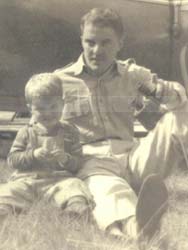
My father was never accepted in northern New Jersey where he sought success.
He never got into the fancy golf clubs to make those important financial
connections. He lied about going to college, which he never did.
 |
And
mostly, he spoke funny, his words not the educated ones from Princeton
or Yale but from the farm, his metaphors from some place like Guernsey:
haywire, hogwash, happy as a heifer in heat. In suburbia such poetry gets
you nowhere and so he struggled harder to succeed. Like the mythic Willy
Loman, he was best as a carpenter and planter; like the late Doug Guernsey,
Willy would have been happy here, too.
They would have loved the hundreds of greenhouses where for generations
the island has produced most of the tomatoes, especially the cherry, for
the United Kingdom. Those little broiled rubies that accompany the Royalty's
bacon and egg each morning probably came from under these buildings of
glass, these fragile yet powerful symbols set against the Nazis' cold
bunkers which like the Cyclops' monomanical gaze are blank and pitiless,
waiting to feast on human flesh. In number and spirit, however, the greenhouses
win: they are everywhere, gathering light. So many times, when looking
across a valley, I could see a sheen like water, each long glass house,
the pool of a river.
And, yes, there are cows, colored golden russet with patches of cream,
ruminating on it all. I remember as a kid trying to milk one, but I went
on to do other things better, a child like many Americans in l999 of the
suburbs and college. I was back now on one of those week-long trips to
our family farm. On a green, green island, "Nobody's" first
son had landed. I'd hiked this little world of war and peace without a
map in a symbolic search for my father and found what I didn't know I
was looking for: me.
The last night on Guernsey I walked a few blocks from my hotel down to
a point along the beach. I climbed up on some rocks that looked curiously
organized, a large flat piece of granite horizontal to some huge verticals
that balanced it. From there I could look east toward Normandy better
than from any of the German bunkers near it, and there were several. Little
did I know until I uncovered a vine-tangled sign that I was perched upon
a Druid dolmen. Having, alas, no flask to lift to toast eternity, I took
from my pocket instead a piece of gum and sat there chewing like my bovine
cousins. "Like the island," I'll say from now on, knowing truly
how to spell my name.
•••
|