LESSON 5
WHAT’S THE BIG
DEAL BOUT
SEQUOIAS?
OBJECTIVE: The students
will learn
a great deal about Sequoias and produce a scaled drawing of a Sequoia,
a human,
and either a Sauroposeidon (tallest of dinosaurs), or an elephant.
EXPLANATION
OF SCALE DRAWING:
“What could we do to make our drawings accurately fit on the page so
that the
size is correct?” (We could use math to make the actual size small to
fit on
our paper)
“Instead of using
feet as my measurement I used inches. Every time I would go up one inch
that
would represent about 12 feet. Let’s see what 12 feet looks like
(demonstrate
12 feet). Now let’s use our pointer finger and thumb to space out one
inch. Now
that we know how our measurements relate to each other let’s try to
figure out
if my drawing is accurate using the dinosaur I drew. (Lay ruler along
the
example.) The first inch is 12 feet.” “How do we
figure out what the next inch
will equal? (add 12 + 12; multiply 12 x
12)
SEQUOIA
FACTS:
·
Only
on the west coast
·
Can
live to be over 2,000 years old
·
Can
weigh up to 2 million pounds
·
Be
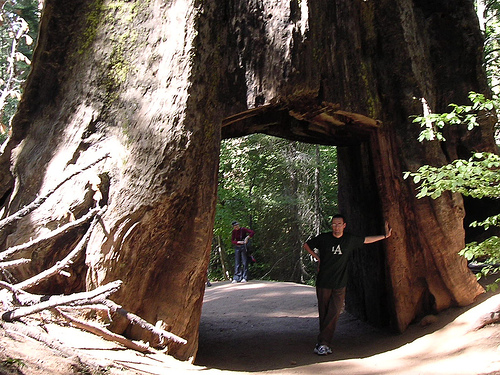
up to 300 feet tall
·
It
would take 121 elephants to weight as much as a full grown Sequoia
·
It
would take 54 of me (I’m about 5’ 5”) stacked up tall to equal the
height of a
full grown Sequoia
·
It
takes a Sequoia up to 800 years to reach full size
·
Yosemite
is home to the “Grizzly Giant” which is a historical Sequoia because it
is the
5th oldest tree in the world
·
Indians
used to start their own fires to burn the forest which the European
Americans
eventually put an end to. Later it was discovered that it was good to
do
prescribed burns and it did less damage than natural fires caused by
lightening
hitting dry trees and brush.
·
Fires
cause populated trees to burn down and make room for Sequoia seeds to
be
planted in the newly opened soil
·
Sequoias
are fire resistant. Fire causes Sequoia’s cones to burst open and
scatter tiny
seeds everywhere
·
Trained,
professional, people now do prescribed burns in forests